








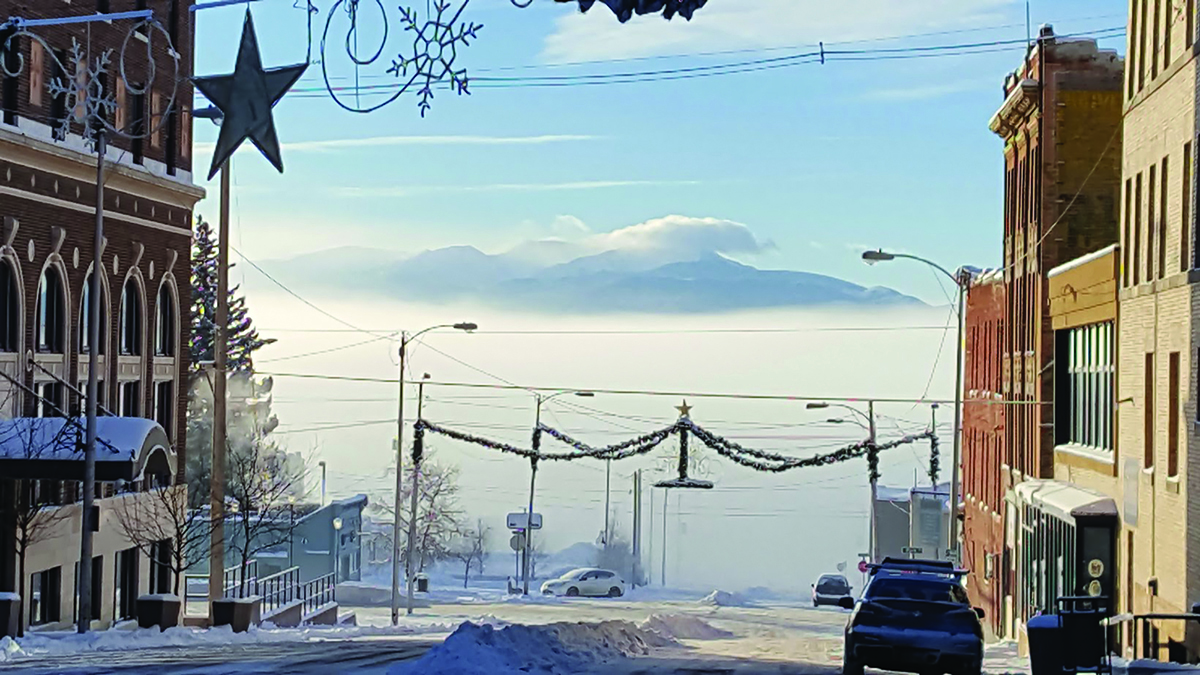
Story By Paul F. Vang
For ButteNews.net
Photo by Jim Larson
Living in our mile high mountain valley, we seldom give much thought to whether we’ll have a white Christmas. Generally, winter weather starts early, compared to other parts of the country, and when it comes, it comes to stay.
Still, during Thanksgiving week, it seemed more like a revisit to October, with bright sunshine and absolutely no snow here in the Mining City. True, we did have a blast of winter in late October, with heavy snow and frigid temperatures. Mild weather returned, the snow melted, and hunters came home from outings thoroughly discouraged, as elk were high in the mountains, far from the nimrods.
How warm was it? It was warm enough on November 15 that I spotted two dandelions blooming on my lawn. Typically, the first dandelions bloom in April, but I can’t recall dandelion blossoms in mid-November, especially when that patch of lawn was under a foot of snow a couple weeks earlier.
Mild weather isn’t rare in December. One hundred years ago, during Christmas week in Butte, daily high temperatures were in the 40s, with lows in the mid-20s. The Butte Miner newspaper was totally silent as to whether there was snow on the ground.
A year later, on December 15, 1924, The Butte Miner warned readers of a blast of arctic air, “Severe cold snap predicted,” was the headline, with temperatures at 10 degrees, and “likely below zero before dawn,” with the story noting, “A summer rain was falling here 24 hours ago,” with a high temperature of 55.
A week later, Butte had a high temperature of +1 F. with an overnight low of -20. West Yellowstone, however, reported a bone-chilling -65, and an estimated 50 to 100 horses dying from cold. Still, on Christmas Day, Butte had warmed to 27, after a morning low of -3 degrees.
If the weather turned cold, the Wein’s store on Park Street advertised a post-Christmas sale on Hart Schaffner & Marx overcoats, starting at $16.35, ranging up to $43.35.
The Butte-Silver Bow Public Archives, incidentally, is an absolute treasure when it comes to looking up what was happening way back when, with its bound collections of newspapers. Considering the status of today’s newspaper industry, it’s remarkable to note that Butte had three daily newspapers, the Butte Miner, the Butte Daily Post, and the Anaconda Standard, which later became the Montana Standard.
The Christmas Day 1952 edition of the Butte Daily Post reported a low of -19 on the preceding day, though it was a balmy -3 at the School of Mines “banana belt.” The following day it was -16 at the airport and -2 at the School of Mines. With the cold temperatures, the paper predicted, “Santa will arrive with icicles in his beard tonight.”
While cold winter temperatures are generally a fact of life at Christmas, the term, White Christmas, didn’t seem to be “a thing” back then. While my research in the Archives was by no means exhaustive, the first reference to White Christmas I noted was in the Butte Daily Post of December 25, 1941, reporting, “A fine snow sifted down on Butte—to keep fresh the blanket that gave the Mining City a White Christmas.”
The previous day’s edition reported on a snowstorm, “A White Christmas was assured for Butte Wednesday, with heavy snowfall on Tuesday night confirmed.”
This being just a couple weeks after Pearl Harbor, war news dominated the front page of the Post, with headlines reporting heavy fighting in The Philippines.
Irving Berlin’s “White Christmas,” became a hit in 1942. The first public performance of the song was by Bing Crosby on his Kraft Music Hall radio show on Christmas Day, 1941. Crosby recorded the song in May 1942, and it became a huge hit in following months, with America’s fighting men and women scattered around the world, and the melancholy words of a Christmas, “just like the ones I used to know,” resonated both on the home front and on the battlefields.
Irving Berlin, according to one account, wrote the song in 1940 while vacationing in California. Berlin wrote hundreds of songs but, surprisingly, didn’t read music. He’d figure out songs and had a secretary who would put the notes on music paper. After a long session at the piano, he told his secretary, “I want you to take down a song I wrote over the weekend. Not only is it the best song I ever wrote, it’s the best song anyone ever wrote.”
The Butte Daily Post of December 23, 1944, proclaimed, “Butte is Coldest City 36 below.” The accompanying story also reported a low of -48 in Elk Park. Also of note was news that the War Production Board allowed resumption of distilling bourbon whiskey in the U.S., on the basis that alcohol production was exceeding war needs.
On Christmas Day, the Post noted continuing sub-zero weather, and reported that the -36 reading on December 23 had been the coldest December day on record, except for 1932, when it hit -37. It was a wintry Christmas, with the Post reporting, “America had a White Christmas in northern states from the Rocky Mountains to the Eastern Seaboard.”
War news dominated the front pages, however, with reports of heavy fighting in Europe, in what became called the Battle of the Bulge, and the “Christmas miracle,” when there was a break in the weather, allowing allied fighter planes to provide air support to the beleaguered ground troops, turning the tide of battle.
That -36 weather of 1944 was eclipsed by the arctic blast on December 23, 1983, when Butte had its coldest temperature on record, reaching a morning low of -52, a temperature reached only once previously, in February 1936.
A work colleague, who worked in the Butte Social Security Office in 1983, sent me a copy of a newspaper clipping reporting on that cold Christmas, after I got transfer orders that brought my wife and I to Butte in 1988.
It didn’t scare us off. In subsequent years, we have experienced many cold and snowy Christmases, though we’re just as happy that -52 is just part of someone else’s good old days.
