












By Jim Larson
ButteNews
Feb 4, 2025
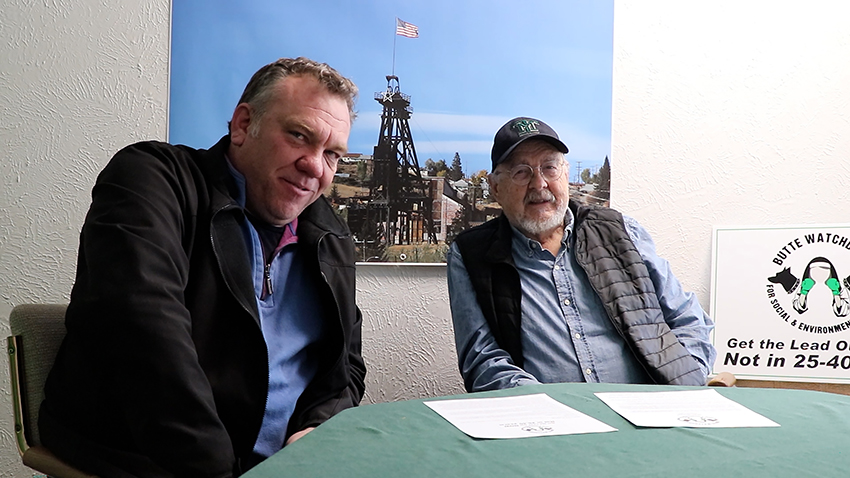
Erik Nyland and Evan Barrett of the Butte Watchdogs Photo by Jim Larson
This article has been updated from the print version that ran in January. It includes a response from the EPA's Molly Roby.
In a December interview at the ButteNews studio, watchdogs Erik Nylund and Evan Barrett barked about lead removal, public participation, and regulatory capture.
The “Watchdogs” had just officially become an organization, but the founding members had long been dubbed watchdogs.
“They started calling us watchdogs because we were watching and reporting things. People thought it was something we would object to, but we loved it,” Barrett said. He noted that Sister Mary Jo McDonald loved the designation. “She not only loved the name, she loved the mission,” he said.
McDonald has long been an advocate for environmental justice in Butte. She was part of the group that successfully sued the state to have Silver Bow Creek’s name restored after it had been designated the “Metro Storm Drain.” She is the Watchdogs’ chairman, a press release said.
Nyland is just wrapping up his time as Regional Director And Natural Resources Liason for Senator Jon Tester. Barrett has long been a fixture in public life in Montana and Democratic politics, including time as a primary advisor to former Montana Governor, Brian Schweitzer.
Getting the Lead Out
“Right now,” Barrett said, “we have the opportunity to urge citizens to comment on the lead cleanup plan.”
The plan, as now proposed by the EPA, might take as long as 25 to 40 years, Barrett said. “My grand kids will have grand kids by then,” he said. The main task now before the Watchdogs is to urge the public during the comment period to urge the EPA to change the time frame. “Get it cleaned up right, but get it cleaned up quickly,” he added. The EPA plan document estimates that the cleanup will take an additional 25 years on top of what has been done already.
Watchdog Nyland pointed to Omaha, Nebraska where contractors are able to clean residential yards at a far more rapid rate than that projected per year for Butte. In Omaha contractors are able to clean up thousands of yards per year, Nyland said. He also said that the Nebraska cleanup was far more transparent than the Butte effort.
Closer to home, until the new lead cleanup plan was proposed, the EPA seemed to have a double standard in its approach to the health of Butte residents as opposed to the health of Anaconda residents.
According to an EPA fact sheet regarding differences in their approach to cleanup of contaminants in Butte as opposed to Anaconda, the agency argued that contaminants in Anaconda come primarily from smelting emissions, while Butte contaminants come primarily from mine wastes. This has led the agency to set different cleanup standards for Butte and Anaconda.
Local reporter Duncan Smith wrote in 2023 that “The EPA uses the 400 ppm standard in Anaconda, but relies on the 1200 ppm standard in Butte, meaning that soil in Butte has to be more contaminated than soil in Anaconda to trigger the same remediation.”
Nyland said that the Butte sites do contain unique features, and the cleanup work to date has been done well, “But we’ve already waited for 32 years.for the cleanup. There isn’t some magic barrier built around Butte that contained aerial emissions. They (the EPA) have also known that.” The EPA fact sheet noted that the emissions from the Anaconda smelter contaminated soil for hundreds of miles. Butte is 25 miles from Anaconda and downwind.
With the agency’s recent proposal to lower the cleanup threshold to 175 ppm, the focus of the controversy has shifted to the proposed lead cleanup plan’s timetable.
Nyland added, “When you start thinking about it, 32 years, how many children have been exposed?”
Nyland asked that Butte be treated with the same urgency that other sites around the country are. “We want science. We want fair. If they can do thousands of yards a year in Nebraska and everywhere else, we can do a few more than 50 a year.”
The EPA’s Molly Roby responded to the Watchdog’s comments:
“The language in the Proposed Plan on page 15 describes EPA’s proposal to sample 640 residences per year from the areas located within the current BPSOU boundary and proposed BPSOU boundary expansion. (Note: there are approximately 7,200 additional households in the expanded BPSOU, plus 4,700 households in the current BPSOU). For comparison, in the community of Black Eagle (the ACM Smelter and Refinery Superfund Site), crews sampled 70 total yards in the 2024 field season. We understand the community’s concern about the timeline and are currently in a public comment period through Friday, February 14, 2025. Written comments are accepted via email (
Roby pointed to language in the cleanup plan that said that the project would take roughly 25 years and that young children, pregnant women, and nursing mothers would receive priority.
Roby is the Remedial Project Manager for the Butte cleanup.
A Captive Audience
Nyland argued that the government works best when conducted in the sunlight. “But the public’s been kept out,” he said. One of the core missions of the watchdogs is to make sure that the public is informed, engaged, active, and not just being gaslit, he said.
Barrett noted that the Montana constitution guarantees the state’s citizens the right to to attend public meetings and to participate in those gatherings. He said that the current EPA meetings regarding superfund in Butte “are half open and half not, and you can’t comment, and you can see evidence of regulatory capture every time you see those meetings, because every time there is a meeting, who’s running it. Who runs the EPA meetings, BP.”
Barrett and Nyland explained that regulatory capture is a situation where the regulated become indistinguishable from the regulators. Barrett noted that this can happen over time after long association.
